

Uncategorized
How Cannabis Concentrates Are Made: A Look Inside
Jan
The world of cannabis has undergone a significant, sometimes dramatic, shift. Gone are the days when your only option was dried flower. Today, you're met with a sprawling menu of products, and right at the top of that list, in terms of potency and popularity, are concentrates. They come in a dizzying array of textures and names: shatter, wax, budder, live rosin, distillate. But have you ever stopped to ask the fundamental question: just how are cannabis concentrates made?
It’s a question we get all the time, and honestly, it’s one of our favorites to answer. Understanding the journey from plant to potent extract isn't just for chemists or industry insiders. It empowers you, the consumer, to make smarter choices, appreciate the craftsmanship involved, and truly understand what you're enjoying. Our team has spent years vetting products and understanding the nuances of extraction, and we believe that knowledge is worth sharing. So, let's pull back the curtain on the fascinating science of turning a beautiful cannabis plant into a powerful, flavorful concentrate.
First Things First: What Are We Even Extracting?
Before we can talk about how things are made, we need to know what we're after. The magic of the cannabis plant isn't in the leaves or stems themselves, but in the tiny, crystal-like structures that cover the flower. These are called trichomes.
Think of trichomes as microscopic chemical factories. They are glands that produce and hold the vast majority of the plant's cannabinoids (like THC and CBD) and terpenes (the aromatic compounds responsible for flavor and scent). When you look at a high-quality cannabis flower, that frosty, sugary coating is actually a dense forest of these trichomes. The goal of every single extraction method, no matter how simple or complex, is to isolate these trichomes and their precious resin from the rest of the plant material. That’s it. That’s the core objective. By stripping away the inactive plant matter, you're left with a concentrated form of the plant's most desirable compounds. Simple, right? Well, the methods for getting there are where things get incredibly interesting.
The Two Roads: Solvent vs. Solventless Extraction
Every concentrate you'll ever encounter started its journey down one of two fundamental paths: extraction using a solvent, or extraction without one. This is the single most important distinction in the world of concentrates, and it dictates everything from the final product's texture and flavor to its price point and purity. Our team has found that understanding this split is the key to navigating the world of extracts with confidence.
- Solvent-Based Extraction: This approach uses a chemical solvent (like butane, propane, CO2, or ethanol) to dissolve the trichomes away from the plant material. The solvent acts as a carrier, stripping the cannabinoids and terpenes. The crucial next step is to completely remove, or 'purge,' the solvent from the final product, leaving only the pure cannabis oil behind. This is the method behind products like BHO, PHO, shatter, wax, and CO2 oil.
- Solventless Extraction: This is the artisan's path. It relies entirely on mechanical and physical forces—like pressure, heat, cold water, or agitation—to separate the trichomes from the plant. It's a method that champions purity above all else, as no foreign substances ever touch the cannabis. Products like kief, ice water hash (bubble hash), and rosin fall into this category.
Let's be honest, this is crucial. Neither method is inherently 'better' than the other; they simply produce different results for different purposes. A high-purity distillate for a vape cart requires a different process than a terpene-rich live rosin meant for dabbing. Here’s a quick breakdown of how they stack up:
| Feature | Solvent-Based Extraction | Solventless Extraction |
|---|---|---|
| Method | Uses chemical solvents (butane, CO2, ethanol) to dissolve trichomes. | Uses physical forces (heat, pressure, ice water) to separate trichomes. |
| Common Products | Shatter, Wax, Budder, Live Resin, Distillate, CO2 Oil | Kief, Bubble Hash, Flower Rosin, Live Rosin |
| Pros | High efficiency and yield, can produce very high THC percentages, scalable. | Considered the 'purest' form, preserves a natural terpene profile, no risk of residual solvents. |
| Cons | Requires meticulous purging to ensure safety, potential for terpene loss. | Often lower yields, more labor-intensive, can be more expensive. |
| Key Concern | Purity and complete removal of the solvent. | Preserving the quality of the delicate trichome heads during separation. |
Now, this is where it gets interesting. Let's explore these methods in detail.
The Scientist's Lab: A Deep Dive into Solvent-Based Methods
Solvent-based extractions are the workhorses of the modern cannabis industry. They are incredibly efficient at producing large volumes of potent, consistent concentrates. However, they demand impeccable precision and a deep understanding of chemistry. We can't stress this enough: these processes should only be performed in professional, licensed laboratories with certified closed-loop equipment. Attempting these at home is catastrophically dangerous.
Butane Hash Oil (BHO) and Propane Hash Oil (PHO)
BHO is likely the most well-known solvent extraction method. It's responsible for a huge variety of textures you see on the market. The process involves packing cannabis material into a tube and 'blasting' it with chilled liquid butane. The butane flows through the material, dissolving the trichomes and carrying them out.
This cannabinoid- and terpene-rich butane solution is then collected. The next and most critical step is purging. The solution is gently heated in a vacuum oven, which lowers the boiling point of the butane, causing it to evaporate completely while leaving the precious cannabis oil behind. The skill of the extractor in controlling temperature and pressure during this process determines the final consistency:
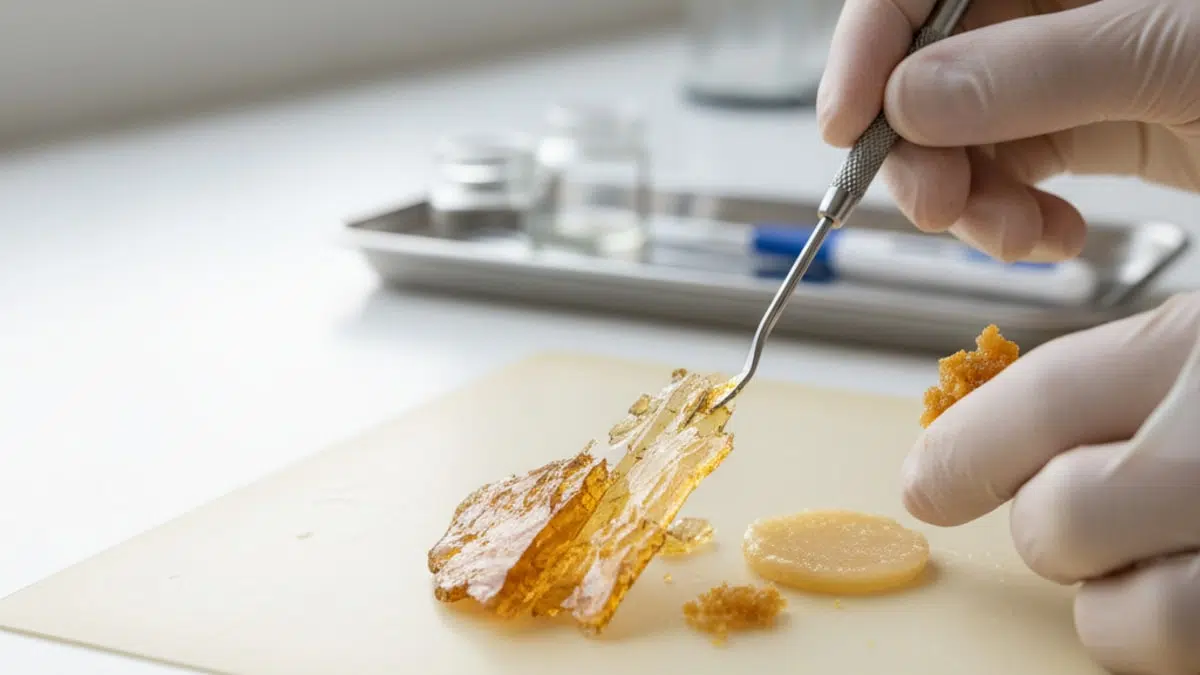
- Shatter: A thin, glass-like, and often translucent concentrate. It's achieved by keeping the extract perfectly still during the purge.
- Wax/Budder: An opaque, waxy, or creamy consistency. This is created by agitating the extract during the purge, which whips air into it and encourages the molecules to crystallize.
- Crumble: A dry, honeycomb-like texture that breaks apart easily. It's typically the result of lower temperatures and a longer vacuum purge.
PHO (Propane Hash Oil) follows the exact same principle but uses propane as the solvent. Propane has a lower boiling point than butane, which means it can be purged at lower temperatures. Our experience shows this can sometimes result in a concentrate with a lighter color and a higher preservation of volatile terpenes, often leading to a 'saucier' consistency.
What about Live Resin?
This is a specific and highly sought-after type of BHO/PHO. The 'live' part refers to the starting material. Instead of using dried and cured cannabis flower, extractors use fresh plants that are flash-frozen immediately at harvest. This process preserves the plant's complete terpene profile—the delicate, volatile terpenes that are lost during the traditional drying and curing process. The result is a concentrate with an aroma and flavor that is remarkably true to the living plant. It’s an absolute explosion of flavor.
CO2 (Carbon Dioxide) Extraction
If BHO is the popular workhorse, CO2 extraction is the high-tech, precision instrument. This method uses carbon dioxide under immense pressure and fluctuating temperatures to achieve a 'supercritical' state. In this state, CO2 acts like a liquid and a gas simultaneously, allowing it to penetrate the plant material and dissolve the trichomes with incredible efficiency.
One of the biggest advantages of CO2 is its tunability. By slightly adjusting the pressure and temperature, extractors can selectively target specific compounds. For example, a lower-pressure 'subcritical' run might pull only the light, volatile terpenes, while a high-pressure 'supercritical' run will pull everything, including cannabinoids, lipids, and waxes.
After the extraction, the pressure is released, and the CO2 simply turns back into a gas and evaporates completely, leaving zero residual solvent. It's an exceptionally clean method. This is why CO2 oil is the go-to choice for many vape cartridges and edibles, where purity and consistency are paramount. It's also used to create THC and CBD distillates, which we'll get to later.
Ethanol Extraction
Using food-grade ethanol as a solvent is another common method, particularly for large-scale production. The process can be done warm or cold. Cold ethanol extraction is preferred because it's better at pulling cannabinoids and terpenes while leaving behind undesirable components like waxes and chlorophyll (which can give an extract a bitter, plant-like taste).
Ethanol is incredibly effective at stripping the plant material, making it highly efficient. The resulting solution is then refined to remove the ethanol, typically using a rotary evaporator. Ethanol extraction is often the first step in creating high-potency THC distillate or the full-spectrum base for tinctures and other ingestible products.
The Artisan's Touch: Exploring Solventless Methods
For many connoisseurs, solventless is the only way to go. This approach is all about mechanical separation. It’s a testament to the idea that the best concentrate is one that is touched by nothing but the elements: water, ice, heat, and pressure. It's a craft that requires patience and exceptional starting material. We've found that you simply can't fake quality with solventless—the flower you start with directly determines the final product.
Dry Sift (Kief)
This is the oldest and simplest form of concentrate. Kief is simply the collection of resinous trichome heads that have been mechanically knocked off the cannabis flower. You've probably seen it collecting in the bottom chamber of a multi-level grinder.
On a larger scale, producers tumble cannabis flower over a series of fine mesh screens. The agitation causes the trichome heads to fall through the screen, separating them from the green plant material. The resulting powder is kief. It can be consumed as is or pressed into hashish.
Ice Water Hash (Bubble Hash)
This is where things get a bit more sophisticated. Ice water extraction uses freezing cold water and agitation to make the trichomes brittle, causing them to snap off the plant. The process involves mixing cannabis, ice, and water in a vessel and stirring it vigorously.
This icy, trichome-rich water is then poured through a series of layered filter bags, each with a progressively finer micron screen. The largest micron bags catch the plant debris, while the finer ones catch the trichome heads of varying sizes and quality. The highest quality hash, often called 'full-melt,' is collected from the finest screens and consists of almost pure trichome heads. When dried, it has a sandy or crumbly texture. It's a beautifully clean and potent product.
Rosin and Live Rosin
This is the undisputed champion of the modern solventless world. Rosin is a concentrate created using only two things: heat and pressure. That’s it. A rosin press uses two heated plates that clamp down with immense force on cannabis material (flower, kief, or bubble hash), causing the resinous sap inside the trichomes to liquefy and squeeze out.
This golden, sappy oil is then collected. The result is a pure, unadulterated expression of the plant's profile. Because no solvents are used, the entire spectrum of cannabinoids and terpenes is preserved in its natural ratio.
- Flower Rosin: Made by pressing high-quality cannabis flower directly. Good, but can contain microscopic bits of lipids and plant material.
- Hash Rosin: The crème de la crème. This is made by first creating high-quality ice water hash and then pressing that hash into rosin. This two-step refinement process results in an incredibly clean, potent, and terpene-rich concentrate. When the ice water hash is made from fresh-frozen material (just like with live resin), the final product is called Live Rosin—arguably one of the most flavorful and sought-after concentrates on the market today.
It’s Not Over Yet: Post-Processing Steps
For many solvent-based extracts, the journey doesn't end after the purge. Further refinement is often needed to achieve the desired purity or consistency.
Winterization (or Dewaxing): This process is used to remove fats, waxes, and lipids from an extract, especially crude oils from CO2 or ethanol extractions. The oil is mixed with ethanol and frozen. At these low temperatures, the undesirable fats and lipids solidify and can be filtered out, leaving behind a much purer, more stable oil.
Distillation: This is how ultra-high-purity THC and CBD distillates are made. Using a technique called short-path distillation, a refined cannabis oil is heated under a vacuum. Different cannabinoids and terpenes have different boiling points, so as the heat rises, each compound can be individually evaporated, condensed, and collected. This process can create a THC distillate that is over 99% pure. However, it also strips out all the terpenes, resulting in a flavorless, odorless, and incredibly potent oil that serves as the base for most vape cartridges and many edibles. Terpenes are often reintroduced later to create specific flavor profiles.
So, Why Does This All Matter?
Understanding how cannabis concentrates are made is about more than just satisfying curiosity. It directly impacts your experience. The extraction method influences a product's flavor, effect, purity, and price. A CO2 distillate cart will offer consistent potency but might lack the complex flavor of a live rosin. That live rosin, in turn, will provide an unparalleled taste experience but will come at a premium price due to the labor-intensive process.
When you browse a curated selection of products, like the one we've carefully assembled on our website, this knowledge becomes your guide. You can look past the clever marketing names and understand the substance of what you're buying. You'll know why one wax is crumbly and another is gooey. You'll understand the difference between 'live resin' and 'live rosin' is not just a letter, but a fundamental divide in extraction philosophy.
We believe an educated customer is a happy customer. The more you know, the better you can tailor your choices to the exact experience you're seeking. Whether you're chasing the purest flavor, the highest potency, or the best value, it all starts with the journey from plant to product. If you're ready to put this knowledge to the test and explore the incredible world of concentrates, you can Get Started Today and see the difference that quality and craftsmanship make.
The innovation in this space isn't slowing down. New techniques and refinements are emerging all the time, pushing the boundaries of what's possible in terms of flavor and purity. It's an exciting time to be exploring cannabis, and we're thrilled to be on this journey with you, helping you navigate the landscape with clarity and confidence. The more you learn, the more you realize that each dab, vape hit, or infused edible is the culmination of a long, intricate, and fascinating scientific process.
Frequently Asked Questions
What’s the main difference between live resin and live rosin?
▼
The key difference is the extraction method. Live resin is made using chemical solvents (like butane) on fresh-frozen cannabis, while live rosin is made using only heat and pressure (solventless) on ice water hash that was made from fresh-frozen cannabis. Both are prized for their exceptional flavor.
Is solventless automatically better than solvent-based?
▼
Not necessarily. A well-made BHO from a professional lab can be cleaner and safer than a poorly made rosin. ‘Better’ is subjective; solventless is preferred by purists for avoiding chemicals, while solvent methods can achieve levels of purity and consistency that are ideal for products like vape carts.
Why are some concentrates dark and others are light and golden?
▼
Color is influenced by several factors. Older starting material, the presence of chlorophyll, and higher extraction temperatures can all lead to a darker color. Lighter, golden hues usually indicate fresh starting material and a refined, clean extraction process.
What does ‘purging’ mean in the context of concentrates?
▼
Purging is the critical final step in solvent-based extraction. It involves using a vacuum oven to gently heat the extract and remove every last trace of the residual solvent (like butane or ethanol), ensuring the final product is clean and safe for consumption.
Are cannabis concentrates safe to consume?
▼
When produced by licensed professionals in a controlled lab and tested for purity, concentrates are safe. The danger lies in black-market products which may contain residual solvents, pesticides, or other contaminants. We always recommend purchasing from reputable sources that provide lab results.
How is THC distillate actually made?
▼
THC distillate is made through a process called short-path distillation. A refined cannabis oil is heated under a deep vacuum, allowing chemists to separate compounds by their unique boiling points. This strips everything away, isolating the THC for an ultra-pure, potent, but flavorless oil.
What is the strongest type of cannabis concentrate?
▼
Technically, THC distillate is the strongest, often testing over 95% THC. However, many users report a more powerful, well-rounded effect from ‘full-spectrum’ extracts like live resin or rosin, which contain a rich mix of cannabinoids and terpenes that work together synergistically.
Why is high-quality rosin so expensive?
▼
Rosin’s high price comes from two things: lower yields and intensive labor. It takes a lot more starting material and hands-on work to produce an ounce of live rosin compared to an ounce of BHO. You’re paying for the premium, solvent-free craftsmanship and the top-tier flower required to make it.
Can I make my own cannabis concentrates at home?
▼
We strongly advise against it. Solvent-based extractions are extremely dangerous and can cause explosions. While a rosin press is safer, it’s an expensive piece of equipment. It’s far safer and more effective to purchase lab-tested products from a trusted provider.
What is the difference between wax and shatter?
▼
Both wax and shatter are forms of BHO (Butane Hash Oil). The only difference is their consistency, which is determined during the purging process. Shatter is left undisturbed to create a stable, glass-like sheet, while wax is agitated or whipped to create an opaque, creamy texture.
Does the extraction method really affect the flavor?
▼
Absolutely. The extraction method has a massive impact on the final flavor profile. Methods that use lower temperatures and preserve delicate terpenes, like live rosin or live resin, will have a much more robust and authentic flavor compared to a high-heat distillate.
What are ‘full-spectrum’ extracts?
▼
A full-spectrum extract is one that contains the complete range of cannabinoids and terpenes present in the original cannabis plant. Concentrates like live resin and rosin are excellent examples. The idea is that these compounds work together in what’s known as the ‘entourage effect’ to produce a more nuanced and effective experience.