

Uncategorized
How to Test Your Concentrates: A Look Inside Quality Control
Jan
Let’s be honest. When you invest in a premium concentrate, you’re expecting a certain level of quality, potency, and flavor. You’re not expecting a science project or a game of roulette with your health. Yet, in a sprawling market, telling the difference between top-tier products and subpar, potentially hazardous offerings is becoming an increasingly difficult, often moving-target objective. It’s a huge concern, and it’s one our team at Splash Brothers takes incredibly seriously.
Knowing how to test your concentrates isn't about being paranoid; it’s about being an educated consumer. It’s about ensuring the experience you pay for is the one you actually get—clean, potent, and enjoyable. We've seen firsthand the significant, sometimes dramatic shift in product quality that proper vetting can achieve. Before we dive into the nitty-gritty, we want to be clear: the ultimate goal is for you to not have to worry about this. That's our job. But empowering you with knowledge is a critical, non-negotiable element of our mission. So, let's pull back the curtain.
Why Even Bother Testing? The Unseen Risks
It’s a fair question. The product looks good, it smells okay, so what could possibly be wrong? Well, a lot, actually. The most significant dangers in the world of concentrates aren't the ones you can see or smell. They’re microscopic and insidious. This is where a discerning eye becomes your best tool.
Our experience shows that the biggest culprits fall into a few key categories. First, residual solvents. Concentrates made using solvents like butane, propane, or ethanol need to be properly purged to remove these chemicals. An incomplete purge leaves behind contaminants that you definitely don't want to inhale. Think about it. You wouldn't drink from a glass that was just rinsed with a chemical cleaner, right? Same principle applies here, but with much higher stakes for your lungs.
Then there are pesticides, fungicides, and heavy metals. These can be absorbed by the source plant from the soil, water, or sprays used during cultivation. The concentration process, true to its name, doesn't just concentrate the good stuff; it concentrates the bad stuff, too. What might have been a trace amount in the original flower can become a potent dose of contamination in the final product. We’ve seen lab reports that would make your head spin, showing levels of contaminants that are just unacceptable. It's a sobering reality.
Finally, there’s the issue of potency and misrepresentation. You might be paying for a product advertised at 85% THC, but in reality, it’s closer to 65%. Or worse, it could be cut with other substances to add weight or mimic a certain texture. This isn’t just dishonest—it’s a waste of your money and undermines the entire experience. You deserve to get exactly what you paid for. Nothing less.
The Visual & Sensory Inspection: Your First Line of Defense
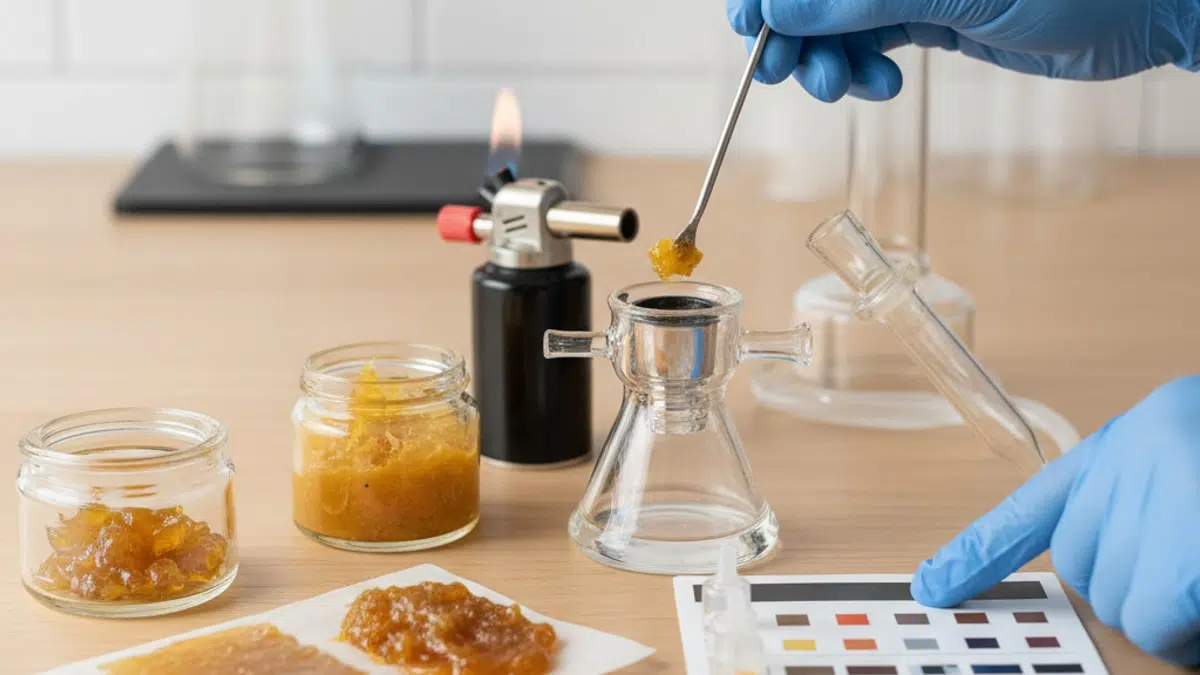
Before you even think about more complex methods, your own senses are your most immediate and accessible tools. This initial inspection won’t give you a full chemical breakdown, but it can absolutely help you spot obvious red flags. Our team does this as a baseline for any potential product, and you should too.
It starts with a simple visual check. What color is it? For products like shatter or wax, a light golden or amber hue is generally a good sign. If it’s excessively dark, greenish, or black, it could indicate the use of old or poor-quality starting material, or even plant matter that wasn't properly filtered out. Be wary. However, color isn't a universal indicator. Live resins and rosins can have a wide spectrum of perfectly acceptable colors, from off-white to deep amber, depending on the strain and process. The key is clarity and consistency. Does it look clean?
Next, what's the aroma? This is where you get a sense of the terpene profile. A quality concentrate should have a rich, complex aroma that is true to the cannabis strain it came from. It might be piney, citrusy, earthy, or gassy. What it shouldn't smell like is a chemical factory. If you get a whiff of sulfur (like rotten eggs), plastic, or a harsh chemical scent, that's a massive warning sign. We’ve also encountered products with overpowering, artificial-smelling fruit scents, which often suggests that non-cannabis-derived terpenes were added to mask a subpar product. Trust your nose. If it smells wrong, it probably is.
And another consideration: texture. How does it feel? Shatter should be stable and glass-like at room temperature. If it's sticky, sappy, or auto-buddering (turning opaque and waxy on its own), it could point to an unstable product, possibly due to an improper purge. Wax should have a consistent texture, whether it's crumbly, buttery, or sugary. Look out for any weird discoloration or foreign particles embedded in the concentrate. A high-quality product will look homogenous and clean all the way through.
Simple At-Home Methods: Getting a Bit More Scientific
Okay, so you’ve done the visual and sensory check, and things seem alright. Want to go a step further? There are a few simple tests you can perform at home to get more information. We can't stress this enough: these are not substitutes for a real lab test. Think of them as the next level of screening to identify potential issues that your eyes and nose might have missed.
The first is the “sizzle test.” It’s incredibly simple. Take a tiny dab of the concentrate and place it on a heated nail or in your banger, but listen carefully before you inhale. Do you hear a loud crackling or popping sound? That sizzle is often a sign of excess moisture trapped inside, which is undesirable. In a worse-case scenario, it could also indicate the presence of residual solvents rapidly boiling off. A clean, well-purged concentrate should melt and vaporize smoothly with a minimal, quiet sizzle, if any at all. A fireworks show is not what you want.
Then there’s the isopropyl alcohol (ISO) test. This is mainly to check for insoluble contaminants. Place a small amount of your concentrate in a bit of high-purity (91% or higher) isopropyl alcohol and stir it. A clean, high-quality concentrate should dissolve completely, creating a translucent, amber-colored solution. If you see particles floating around, a cloudy residue, or anything that refuses to dissolve, you’re looking at contaminants. This could be anything from plant lipids and waxes to dust or other unwanted adulterants. It's a simple, effective way to see what might be hiding in plain sight.
Finally, there’s the melt test. How does the concentrate behave when it melts? A pure concentrate should melt evenly into a clean oil. If it leaves behind a hard, charred, or white, chalky residue on your dabber or nail, that’s a major red flag. This kind of residue often points to contaminants or cutting agents like pine resin—something that has unfortunately been found in illicit market products. The residue from a quality dab should be minimal and easy to clean up with a cotton swab, not a hard, crusty mess.
Again, these tests are about spotting disqualifiers. They help you say “no” to a bad product, but they don't definitively say “yes” to a great one. For that, you need to go to the source of truth.
The Gold Standard: Understanding Professional Lab Testing
This is where it gets serious. This is the standard we hold our partners to. Professional, third-party lab testing is the only way to know for sure what's in your concentrate. Any reputable brand or service—and we count ourselves among them—should be able to provide a Certificate of Analysis (COA) for their products. If they can’t or won’t, you should walk away. Period.
A COA can look intimidating, like a page out of a chemistry textbook, but it's actually pretty straightforward once you know what to look for. Here's what our team focuses on:
-
Potency Profile: This is the part most people look at first. It breaks down the cannabinoids by percentage. You’ll see values for THCA, Delta-9 THC, CBDA, CBD, and others. This is how you verify that the product’s advertised potency is accurate. It's the ultimate truth-teller.
-
Terpene Analysis: This section shows you the flavor and aroma profile in hard data. It lists the specific terpenes (like Myrcene, Limonene, Pinene) and their concentrations. A rich and diverse terpene profile is usually the sign of a high-quality product made from excellent starting material.
-
Contaminant Screening: This is arguably the most critical part of the COA. A “full-panel” test will include results for several categories:
- Residual Solvents: Checks for leftover butane, propane, ethanol, etc. The report will show the parts per million (PPM) found, which should be well below the state-regulated safety limit.
- Pesticides: Screens for a long list of common and uncommon agricultural pesticides. The result should be “ND” (None Detected) or “Pass.”
- Heavy Metals: Tests for lead, arsenic, mercury, and cadmium. Again, you want to see a “Pass” result here.
- Microbials & Mycotoxins: Checks for mold, mildew, E. coli, salmonella, and other biological contaminants. This is non-negotiable for safety.
Reading a COA is your superpower as a consumer. It cuts through all the marketing hype and fancy packaging and gives you the raw, unbiased facts about what you're consuming. It’s the definition of transparency.
Here’s a quick breakdown of how these testing methods stack up:
| Feature | Visual & Sensory Check | At-Home Chemical Tests | Professional Lab Testing (COA) |
|---|---|---|---|
| Accuracy | Low (Subjective) | Low to Medium (Indicator Only) | High (Quantitative & Definitive) |
| Cost | Free | Minimal ($) | Expensive ($$$) |
| Tests For | Obvious flaws in color, smell, texture | Insolubles, excess moisture/solvents | Potency, Terpenes, Solvents, Pesticides, Heavy Metals, Microbials |
| Reliability | Highly variable, depends on experience | Can produce false positives/negatives | The industry gold standard; highly reliable when done by an accredited lab |
How We Ensure Quality: The Splash Brothers Promise
Now, this all might sound like a lot of work. You shouldn't have to be a part-time chemist to enjoy concentrates safely. And honestly, you don't have to be. That's where we come in.
At Splash Brothers, our entire model is built on trust and quality curation. We don't just add any product to our menu. Our team meticulously vets every single brand and product line before it ever gets listed on our website. We do the legwork so you don't have to. We demand full-panel COAs from our partners. We engage with them, understand their processes, and ensure they meet our unflinching standards for safety and quality.
This approach—which we've refined over years—means that when you browse our selection, you're looking at a curated collection of products that have already passed the test. You can explore different textures, potencies, and terpene profiles with the peace of mind that comes from knowing it's been vetted by experts who are as passionate about quality as you are. It’s about more than just convenience; it’s about confidence.
Ready to see what a difference curated quality makes? You can browse our full menu of premium, fully-vetted concentrates right now. It's simple, safe, and delivered right to you. Get Started Today and experience the confidence that comes with a trusted source.
Your journey with concentrates should be one of discovery and enjoyment, not anxiety and uncertainty. By learning a few simple checks and, more importantly, by choosing a source that prioritizes transparency and rigorous testing, you take control of your experience. You ensure that every dab is as clean, safe, and incredible as it was meant to be.
Frequently Asked Questions
What does it mean if my shatter turns into ‘sugar’ or ‘budder’?
▼
This process, called nucleation or ‘auto-buddering,’ happens when lipids separate or terpenes are especially high. While not necessarily a sign of a bad product, it can indicate it’s older or was stored improperly. It mainly affects texture, not necessarily safety, but very stable shatter is often a sign of a more refined process.
Is clear or ‘see-through’ concentrate always better?
▼
Not at all. While extreme clarity in shatter can be a sign of purity, many other high-quality concentrates like live rosin and badder are opaque by nature. Color and clarity are just one piece of the puzzle; the aroma and, most importantly, the lab results tell the real story.
How can I find the Certificate of Analysis (COA) for a product?
▼
Reputable brands often include a QR code on the packaging that links directly to the lab results. If not, you can usually find it on their website. At Splash Brothers, we ensure all our products are backed by this documentation, taking the guesswork out of the equation for you.
Are at-home concentrate test kits reliable?
▼
Home test kits that claim to measure THC potency or detect contaminants have very limited reliability. They can be inconsistent and are no substitute for professional lab testing (HPLC/GC-MS). We recommend relying on the producer’s third-party COA for accurate information.
What’s the most dangerous potential contaminant in concentrates?
▼
While residual solvents are a concern, our team believes the most insidious dangers are pesticides and heavy metals. These compounds can accumulate in the body over time and pose long-term health risks, which is why we are so strict about full-panel testing that screens for them.
Can I test for the difference between CBD and THC at home?
▼
No, there is no simple or reliable way to differentiate between specific cannabinoids like THC and CBD at home. This requires sophisticated lab equipment like High-Performance Liquid Chromatography (HPLC). The only way to know the exact cannabinoid profile is by reviewing the product’s COA.
Why does my concentrate sometimes taste harsh or like chemicals?
▼
A harsh, chemical taste is a major red flag. It can indicate the presence of residual solvents from an improper purge, or it could be a sign of pesticides or other contaminants. A quality concentrate should have a clean taste that reflects its terpene profile.
Does a darker color always mean a lower quality concentrate?
▼
Not necessarily. While a very dark or green color in BHO can suggest poor starting material, some solventless rosins can be darker due to the specific strain and pressing temperature and still be exceptionally high quality. Context is key, but in general, a clean, golden-amber hue is a good sign for extracts like shatter and wax.
What is CRC and is it bad?
▼
CRC stands for Color Remediation Column, a filtration technique used to lighten the color of an extract. It’s not inherently bad and can be used to clean up a good product. However, some producers use it to mask very low-quality starting material, so it’s a ‘trust but verify’ situation—always fall back on the COA and the brand’s reputation.
How should I properly store my concentrates to maintain quality?
▼
To preserve terpenes and consistency, we recommend storing your concentrates in an airtight glass or silicone container. Keep them in a cool, dark place like a refrigerator. This prevents degradation from heat, light, and air, ensuring your product stays fresh for longer.
Is it safe to consume a concentrate that fails the ‘sizzle test’?
▼
We strongly advise against it. A loud sizzle or crackle often indicates trapped moisture or, more worrisomely, residual solvents. Inhaling these substances can be harmful, so it’s best to err on the side of caution with any product that reacts this way.